
Please be aware that this is an early version of this software and there are still numerous bugs.
You can find a video tutorial at Mike Le Page’s channel on YouTube. Alternatively, you can find the keyboard and mouse/trackpad controls by cycling through the HUD options with the H key, also remember that trajectory mode (spacebar), and lookup mode (tilda key) cannot be active at the same time:
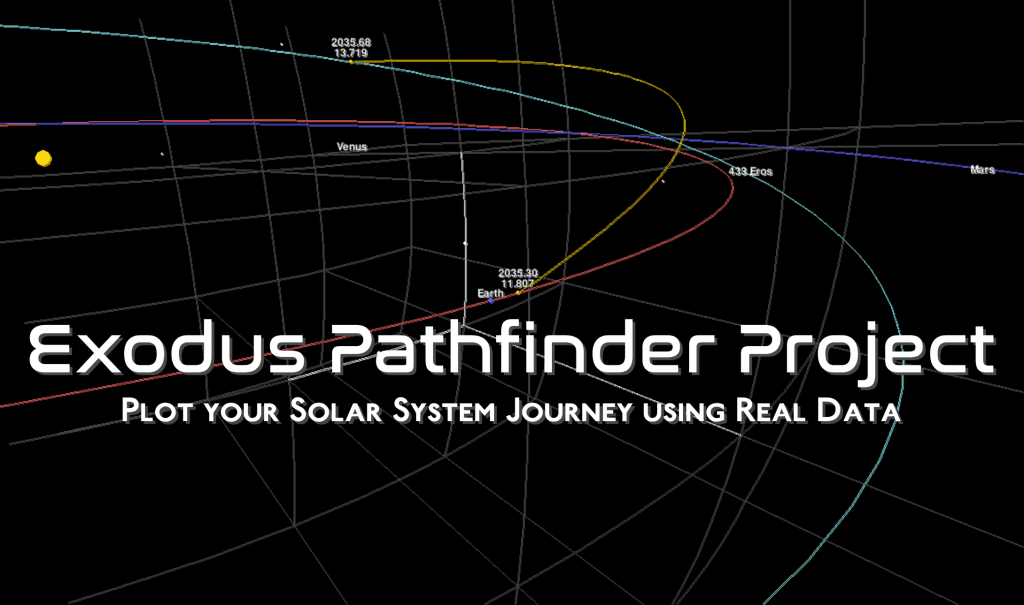
Here’s a question: What is a map?
For our purposes, it’s this: a map is a description of a set of features in a region, and how they relate to each other in time and space. Most often, it is useful because it helps us do a thing called pathfinding – the act of navigating from one place to another – whilst avoiding obstacles like rivers, mountains or traffic.
One could argue that there are no good maps of the solar system, because – while it is pretty well known where most things are – it’s very difficult for anyone without knowledge of orbital dynamics to actually imagine navigating a ship around the solar system.
What the Exodus Pathfinder Project is, is a first attempt to make this pathfinding job far simpler and more intuitive. To navigate around the solar system – especially the asteroids – with real position data supplied by NASA’s Jet Propulsion Laboratory. It currently includes around ten thousand of the biggest asteroids (>10km diameter).
The reason the asteroids will be important to humanity, is as an approach to deal with the major obstacle in space, the radiation problem posed by Galactic Cosmic Rays (GCRs). On the scale between “not a problem” and “a complete deal-breaker”, GCRs are definitely closer to the latter than the former.
Consider that one third of the effective radiation dose in space comes from the top 1% of highest energy GCRs (HZEs) – particles that can only be stopped by many metres of shielding material. The current lifetime limit for radiation exposure limits astronauts to taking on an additional cancer risk of 3% (over and above the ~40% lifetime risk we all have). Because of this, the best case scenario for an astronaut crew travelling around the solar system – even if we shielded the other 99% of the radiation – the best case scenario would limit their interplanetary missions to between 3 and 6 years.
Play with the app for a little while and you’ll see this doesn’t get us very far.
The necessary shielding to increase these career limits is massive and would be impractical to add to interplanetary crewed spacecraft, but to paraphrase an old expression, “if you cannot bring the shielding to the spacecraft, you bring the spacecraft to the shielding.”
We propose that “asteroid-hopping” will become the main method by which humanity travels across the solar system, using the asteroids as sites for radiation shelters. Initially situating their spacecraft in craters or other natural depressions, successive crews will enlarge these shielded areas until whole settlements can be constructed. The specific architecture of the spacecraft/settlements is left to the players’ imagination.
The graphics are intentionally simple, as the real aim is to show a simple way for users to understand the balance between:
- Crew-time exposed to GCR radiation,
- the amount of propellant (delta-V) that enables transits between locations,
- and radiation shelter construction at asteroids (creates propellant, and protects crew from radiation).
Some notes on the GCR / crew survival model:
- A simple crew-survival model projects the percentage of crew still alive
- Player crew starts as half 50 year olds, half 55 year olds, half women and half men
- The model shows a percentage of expected deaths due to age, as well as extra cancer mortality due to GCR (shown in brackets).
- The model projects how coming solar cycles will affect ambient GCR levels
The citizen science aspect of this project is to log every journey (make sure to press SHIFT + Q to end your game) and this generate a database of potential journeys taken by players. Every journey will be logged so we can eventually do meta-analysis on the data, and usernames will be recorded for those who score high enough to enter the highscore tables, or those who become patrons of the project on Patreon.
Each radiation shelter created is assumed to generate propellant for the spacecraft, and the score is based on the radiation shelter created, the crew survival, and how efficient the player was with propellant.


 Exodus Space Systems